How to Set Intentions that Support Your Wellbeing this Year
Jan 10, 2026
How to Set Intentions that Support Your Well-being this Year
Learn why resolutions often fail and how setting intentions can support wellbeing and prevent burnout– especially for educators and healthcare workers.
New Year’s Day has always been one of my favourite days — a time to refresh, hit the reset button, reflect on the year behind us, and quietly consider our hopes for the year ahead.
Like many people, I used to approach January with a list of resolutions: improving my physical or mental health, nurturing relationships, making better financial decisions, or becoming more productive and organised. The intentions were good. But I have to admit, sometimes my ambition got the best of me.
The goals sounded great in January…
By March, not so much.
The reality is that most resolutions don’t last. By early spring, nearly 80% of New Year’s resolutions are abandoned, and fewer than 10% of people feel successful in keeping them. Often, resolutions fail because they’re unrealistic, overly rigid, or lack a clear plan — like deciding to lose 30 pounds, overhaul all habits at once, or rely on willpower alone.
For educators and healthcare professionals already operating under chronic stress, over-reaching goals can do more than disappoint — they can actually fuel burnout.
Burnout doesn’t come from caring too little.
It comes from asking too much of ourselves for too long.
In many ways, without realising it, we end up fueling our own exhaustion.
How Over-Reaching Goals Fuel Burnout
They activate chronic stress.
Big, rigid goals — “I will completely change my routine” or “I must fix everything this year” — keep the body in a constant state of pressure. Instead of motivating us, they send a message to the nervous system:
“I’m behind. I’m not enough yet.”
Over time, this sustained stress response leads to emotional exhaustion — a core component of burnout.
They create an all-or-nothing mindset.
When goals allow no room for real life, one missed day quickly turns into “I blew it.” This cycle increases guilt, self-criticism, and shame — emotions that accelerate burnout rather than prevent it.
They ignore current capacity.
Burnout isn’t a motivation problem — it’s a capacity problem. When goals are based on who we wish we were rather than who we currently are, we overdraw our emotional and physical energy, push past warning signs, and delay rest and recovery. This is especially dangerous in caregiving professions, where people already give more than they receive.
They disconnect effort from reward.
When goals are too large, progress feels invisible, wins feel unreachable, and effort goes unacknowledged. Over time, this reduces our sense of accomplishment — another hallmark of burnout.
They reinforce the “fix yourself” narrative.
Over-reaching goals often come from the belief, “Once I change enough, I’ll finally feel better.”
Burnout recovery works the opposite way: feeling safer and supported allows change — not pressure.

Resolutions push. Intentions rewire. Resolutions rely on pressure and future promises, often activating the nervous system’s survival response. Intentions work differently—they shape neural pathways through safety and repetition. Every time we speak an “I am,” we send a signal to the brain about identity and belonging, teaching the nervous system who it’s safe to become. Over time, these gentle signals move us out of burnout and back into regulation, presence, and joy.(READ the JANUARY 'LIGHTBULB LESSON' on SUBSTACK or LINKEDIN)
Why Intentions Are Burnout-Protective
My shift from setting resolutions to setting intentions began years ago, when I attended a World Class Life Conference to deepen my own self-awareness. The pre-assignment was to write 100 things that I wanted.
One hundred things.
That exercise was eye-opening. We spend so much time worrying about everything and everyone else that we often forget to think about our own needs. I realised that successfully setting an intention begins with being clear about what we truly want — not what we think we should want.
That moment became the catalyst for a different approach. Most resolutions ask us to do more, fix ourselves, or be better — without first addressing how we are actually feeling. So I stopped making resolutions and started setting intentions for the year ahead.
Intentions work because they meet us where we are and allow growth without pressure. They are flexible, value-driven, and supportive of sustainable change. Rather than demanding perfection, intentions encourage consistent, small practices over time.
This year, instead of committing to a resolution, spend some time thinking about what you really want. Rather than resolving to do something, set an intention that supports your well-being.
Start by Exploring These Categories
You might begin by reflecting on one area where you’d like to place your focus this year:
Financial: Your ideal financial life and sense of security
Fun & Freedom: What brings you joy, play, and lightness
Work: What you’re good at and what energises you professionally
Relationships: Partner, family, friends, and colleagues
Health: Physical, mental, and emotional well-being — how you want to feel
Choose just one category to begin. Remember, this isn’t about changing everything at once.
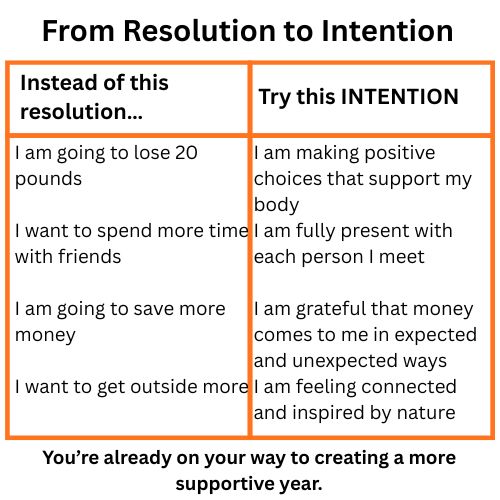

Put your intention in the present tense, as if it’s already true.
Begin with the words “I am…” — powerful language that strengthens belief and awareness.
Choose words that feel uplifting and emotionally resonant.
Return to your intention often. Post it where you’ll see it — a mirror, journal, or phone reminder.
Before going to sleep, acknowledge moments when you lived in alignment with your intention that day.
Positive words help boost self-esteem, reduce stress, improve mood, and build resilience. What we repeatedly focus on shapes how we experience our lives.
Remember: what you put your attention on grows stronger.
Make this the year you are gentle with yourself. Baby steps matter. When you look back, you won’t just see outcomes — you’ll see progress.
And that’s where real change begins.
If this idea of setting intentions resonates with you, it’s something we explore more deeply in Burnout to Joy: Love Your Work Again.
In our upcoming pilot class beginning February 22nd 2026, we support educators and healthcare professionals in slowing down, reconnecting with why they chose their profession, and setting intentions that nurture their energy, wellbeing, and sense of purpose — not just their productivity.
If you’d like to learn more about the pilot program, you’re warmly invited to explore the details and see if it feels like the right next step for you.
Stay connected with news and updates!
Join our mailing list to receive the latest news and updates from our team.
Don't worry, your information will not be shared.
We hate SPAM. We will never sell your information, for any reason.